
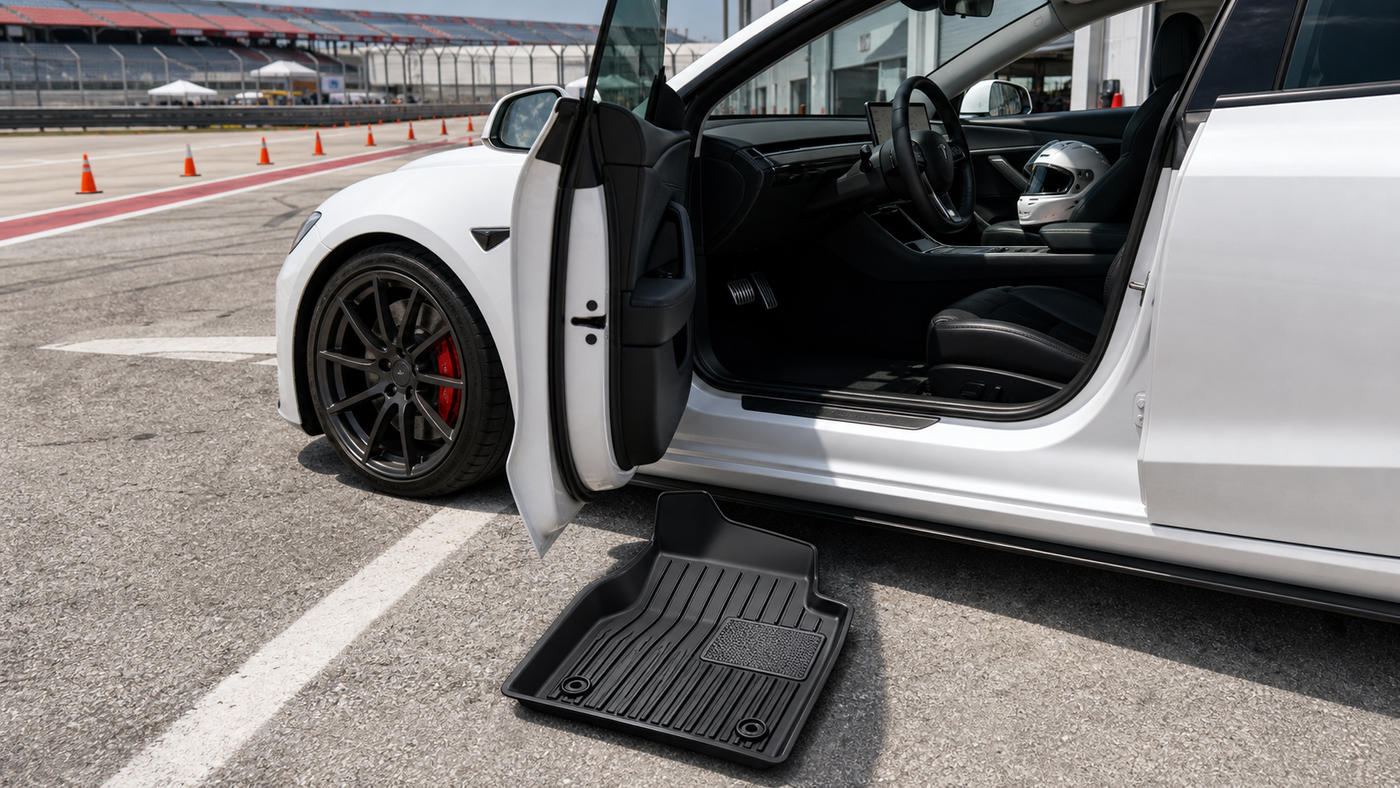
The Model 3 Performance changed the floor mat calculus
The 2024 Model 3 Performance is a legitimately fast car. 510 horsepower, 3.1-second 0–60, a chassis that can genuinely hang at a weekend track day. It's also — and almost nobody talks about this — one of the most demanding cars in the Tesla lineup on floor mats.
Here's why. On a street drive, your right foot moves maybe a dozen times between the pedals. On a track day, it moves hundreds of times per session, with far more force on each input. The driver's mat on a Performance car used hard absorbs wear in a day that a commuter car takes a year to accumulate.
Most "universal fit" Tesla Model 3 mats cannot physically handle this. Here's what fails, why, and what to run instead.
Failure mode 1: Mat migration under hard braking
Every cheap tray-style mat sold on Amazon has the same weakness: light weight plus a flat, low-friction backing means the mat slides forward under hard deceleration. In daily driving, you never brake hard enough for this to matter. On a track brake zone, the mat can shift 1–2 inches forward per lap.
The failure mode: after a few sessions, the driver's mat has crept up over the pedal pivot point. Now your right foot is catching the mat edge on every brake release. That's both slow (you're fighting the mat) and dangerous (the mat can bind against the accelerator).
The fix: mats that lock to the factory floor anchors. Tesla put those anchors there for a reason. Cheap mats either don't have anchor holes or use a flimsy plastic grommet that pops off after a few hard stops. Properly engineered mats use Tesla's exact anchor geometry.
Failure mode 2: Heat deformation
A Model 3 cabin parked in a sunny paddock in summer hits 140°F on the dash and 120°F on the carpet. Add a hot right foot coming off a 5-minute track session and the driver's mat is under legitimate thermal stress. Cheap PVC mats curl, warp, and off-gas — you can smell it in the cabin on the drive back to the paddock.
TPE (thermoplastic elastomer) rated for -40°F to 158°F handles track heat without deformation. PVC does not. Carpet mats don't deform but they absorb every track-day smell for the rest of their life.
Failure mode 3: Pedal heel pad wear
On a track day, your right heel pivots on the floor mat hundreds of times. The pad where your heel sits wears through cheap mats in a single weekend. Once the pad is worn, you're heel-pivoting directly on the factory carpet — and the factory carpet dies fast.
Properly engineered Model 3 Performance mats have a reinforced heel pad area in the driver's mat specifically for this. Look for mats that visibly thicken the material at the heel position, not a uniform-thickness mat.
Failure mode 4: The spilled Gatorade problem
At a track day, every driver has drinks in the car — water, electrolyte mix, coffee. They slosh. Cheap mats with no raised edge send the spill straight to the carpet. Mats with a proper ½-inch lip contain the spill at the mat, and you hose them off at the end of the day.
This sounds trivial until you stain the light-colored carpet on a 2024 Highland Performance and discover the detailer quote to remove sugar stains from EV-cabin carpet is $180.
What actual track-day Model 3 Performance drivers run
Talk to the people actually doing Model 3 track days at places like Laguna Seca, COTA, and VIR, and a consistent setup emerges:
- TPE mats rated -40°F to 158°F — heat stability is non-negotiable
- Factory anchor lock — no foam, no magnets, no "rubber nub" anti-slip
- ½-inch raised perimeter — for drink containment
- Reinforced heel pad — for the concentrated pivot wear
- Low-profile edge at the pedal box so the mat doesn't interfere with heel-and-toe (yes, even in a one-pedal EV — many Performance drivers disable regen for track and run traditional brake technique)
Our Tesla Model 3 Performance floor mats meet all five specs and are validated against factory Tesla floor anchors — the mats physically clip in and will not shift under 1.0g+ braking.
The 2024 Performance (Highland) wrinkle
The 2024 Performance is a Highland chassis, so its footwell geometry is different from a 2022 or 2023 Performance. Track-day drivers who upgraded from a 2022 Performance to a 2024 cannot reuse their old mats — they won't fit the new footwell. Every 2024+ Performance needs Highland-specific tooling. Full breakdown in Tesla Model 3 Highland: What Changed in the Footwell.
What to do the night before a track day
- Pull the passenger and rear mats — you don't need them at the track and they become loose objects in a crash
- Re-seat the driver's mat and verify the anchor clips are engaged
- Throw a microfiber and a small spray bottle in the door pocket for mid-session cleanup
- Make sure the drink holder has a proper leak-proof bottle, not a coffee cup
- Double-check no loose items in the front passenger footwell (water bottles in the footwell become projectiles under braking)
What to do after a track day
- Pull the driver's mat out, hose it down, let it air dry
- Vacuum the driver's footwell — track grit gets everywhere
- Inspect the heel pad area for wear or scuffing
- Reinstall the passenger and rear mats
- Wipe the pedal faces — dust buildup reduces pedal feel on street drives
The bottom line
The Model 3 Performance is a real performance car. Track-day use accelerates floor mat wear by roughly 10x compared to daily driving. Matching the mat to the use case — TPE, anchored, lipped, reinforced — is the same discipline you'd apply to tires or brake pads. Running the cheap mat is like running the stock brake pads at a track day: it works until it doesn't, and the failure is expensive.
Check out the full SUPER LINER Model 3 range — every Performance-year SKU meets the five track-day specs above.