
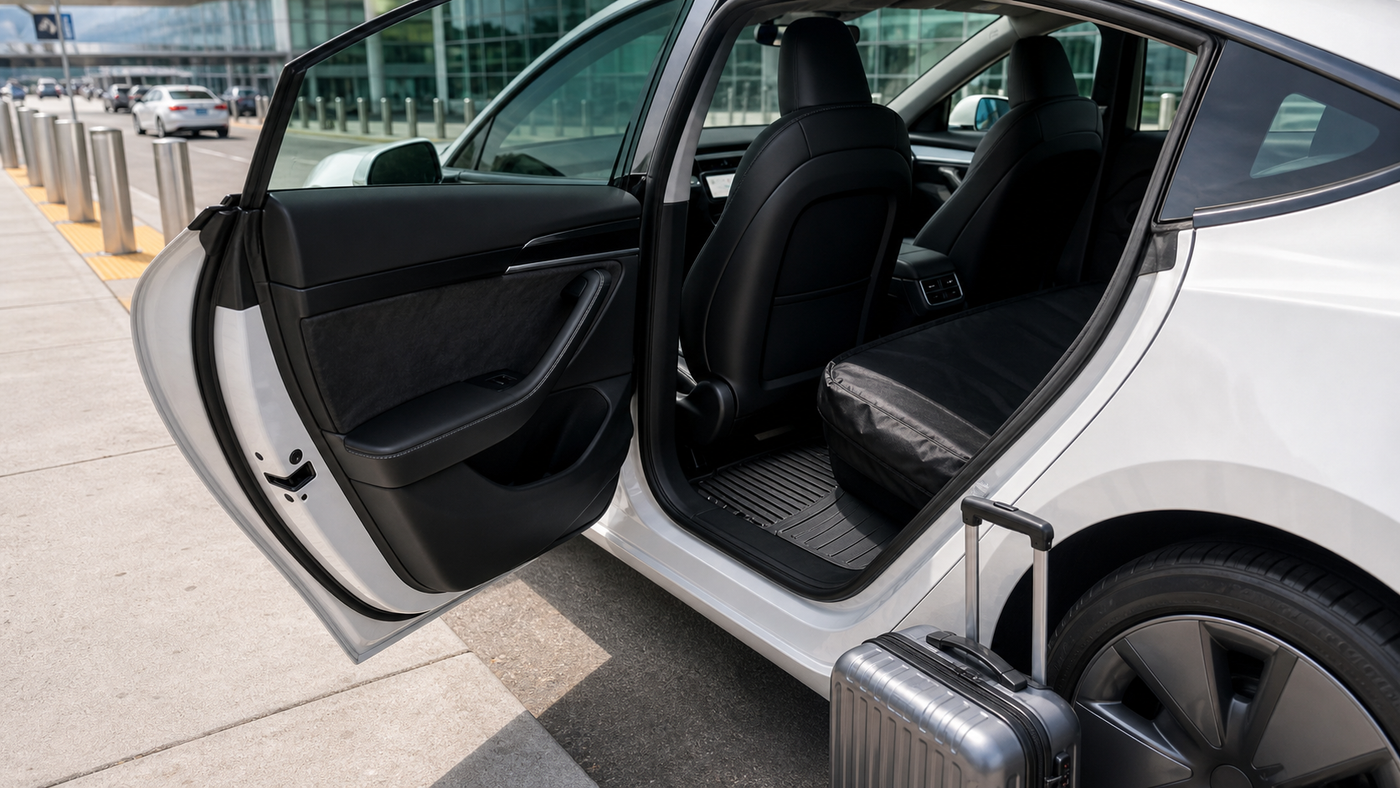
The Model 3 is the #1 rideshare EV. Its interiors look like it.
Drive for Uber or Lyft in any major US city long enough and you'll notice the same car show up over and over: the Tesla Model 3. Low operating cost, great range, HOV-lane access in most markets, and the EV federal incentive math that made the 2023–2024 buying surge. The Model 3 Standard Range trim was practically designed for rideshare economics.
What the economics ignore is interior wear. A full-time rideshare Model 3 hits 30,000–50,000 miles a year, almost all of it with people the driver doesn't know sitting in the back seat. Those passengers bring dirt, food, rain, dog hair, vomit (yes, statistically), and the occasional Uber Eats spill. The Model 3's light-colored cabin — increasingly common on newer trims — is brutally unforgiving.
This is the interior protection kit that actual full-time Model 3 rideshare drivers run, based on conversations with drivers in the Tesla rideshare subreddits and our own customer base.
The #1 cost of unprotected rideshare use
At trade-in, a Model 3 with worn driver-seat bolsters, stained rear carpet, and scuffed door sills typically wholesales for $1,500–$2,500 less than a private-use Model 3 with the same mileage. The "rideshare" check-box on the CarMax appraisal form alone costs ~$600 on average. Visible carpet stains add another $400–$900 depending on severity.
That means every $80 mat set that doesn't prevent a $900 stain is a negative ROI. Rideshare math is unforgiving, and "I'll just clean it later" is how drivers end up with four-figure reconditioning bills at trade-in.
The kit that actually survives
1. Full-coverage TPE mats — front and rear
TPE (thermoplastic elastomer) is the only material that holds up to a rideshare cadence. Carpet mats are dead by month three. Rubber mats go slick and cup water. PVC mats off-gas in a sealed EV cabin. TPE is tough, easy to hose off, and doesn't turn into a skating rink when a passenger brings wet shoes in.
Specifically, you want mats with raised edges at least ½ inch tall (containment matters when you can't control what the passenger brings in) and a non-slip backing that locks to the factory floor anchors so they don't slide under the pedals during a hard brake.
Our heavy-duty Tesla Model 3 floor mats are built for this exact use case — TPE construction, ½-inch lip, year-specific tooling for both pre-Highland and Highland cars.
2. Rear seat cover (the one thing most drivers skip)
The rear seat itself takes more abuse than the carpet. A tailored rear seat cover — pulled tight so passengers don't notice it's there — protects the main touchpoints: the seat cushion, the seat back, and the armrest pull-through. Universal covers slip and bunch. Model 3-tailored covers stay put.
3. Door sill protectors
Every passenger entering or exiting drags their shoes across the door sill. After 10,000 rides, the paint on unprotected sills is gone. Sill protectors are $20–$40 and prevent a $300 paint touch-up at trade-in.
4. Trunk liner
Luggage, groceries, airport runs — the trunk takes a pounding. A TPE trunk liner with raised edges prevents carpet staining and makes cleanup a hose-off. Match it to your generation (pre-Highland and Highland trunks are different shapes). See our year-by-year fitment guide for the exact match.
5. Cabin air filter upgrade
Not a surface you see, but the single biggest complaint in the rideshare subreddit is cabin smell. Passengers bring perfume, food, sweat, smoke residue from their clothes. A HEPA cabin filter upgrade (swap at 15,000 miles instead of the Tesla-recommended 25,000) keeps the car from developing the "Uber smell" that kills ratings.
The daily cleaning routine drivers actually follow
- Between rides (30 seconds): Quick visual check of the rear seat and floor. Pick up any visible trash. This sounds obvious but is what separates 4.9-star drivers from 4.6-star drivers.
- End of each shift (5 minutes): Pull the floor mats out, shake over a trash can, wipe with a damp cloth. Wipe down door sills and armrest.
- Weekly (20 minutes): Hose down the TPE mats, vacuum the car, wipe touch surfaces with an alcohol wipe (avoid the screen).
- Monthly: Deep clean the rear seat cover, re-stretch if it's loosened, check door sill protectors for lift.
- Quarterly: Replace cabin air filter if you're on the accelerated schedule.
This routine, run religiously, keeps a rideshare Model 3 looking near-new at 100,000 miles. Skipping it is why rideshare cars look "ridden hard" at 50,000.
The light-interior problem
If you ordered a 2024+ Highland in the white/creme interior — huge mistake for full-time rideshare. Light carpet plus strangers plus 30,000 miles a year equals permanent staining by month twelve. If you already have one: TPE mats with maximum lip height are mandatory, not optional. Skipping them on a light-interior Highland is why rideshare-specific trade-in values on that trim are the lowest in the Model 3 lineup.
More detail on Highland's specific interior risks in Tesla Model 3 Highland: What Changed in the Footwell.
What ruins a rideshare Model 3 fastest
- Skipping the rear-seat cover ("passengers will notice" — they won't, if it's tailored)
- Using carpet floor mats because they "look nicer" — they die in week six
- Ignoring door sills until they're already scuffed
- Cleaning the cabin only when it starts smelling — by then the fabric has absorbed it
- Running the Tesla-recommended cabin filter interval at rideshare mileage
The bottom line
Rideshare is a business. Every $100 spent on interior protection in year one returns $200–$400 at trade-in three years later. Model 3 drivers who treat interior protection as "nice to have" are the ones taking the big haircut at resale. Drivers who kit out on day one are the ones selling private-use-equivalent cars at 100,000+ miles.
If you drive a Model 3 for a living, start with the SUPER LINER Model 3 collection — rideshare-grade TPE, full-cabin coverage, and a lifetime replacement warranty in case a passenger does something memorable.